Treatments · Root canal treatment
Root canal
treatment.
When decay or infection reaches the nerve, we clean and fill the inside of the tooth instead of extracting it. The tooth stays in your mouth.
What it does
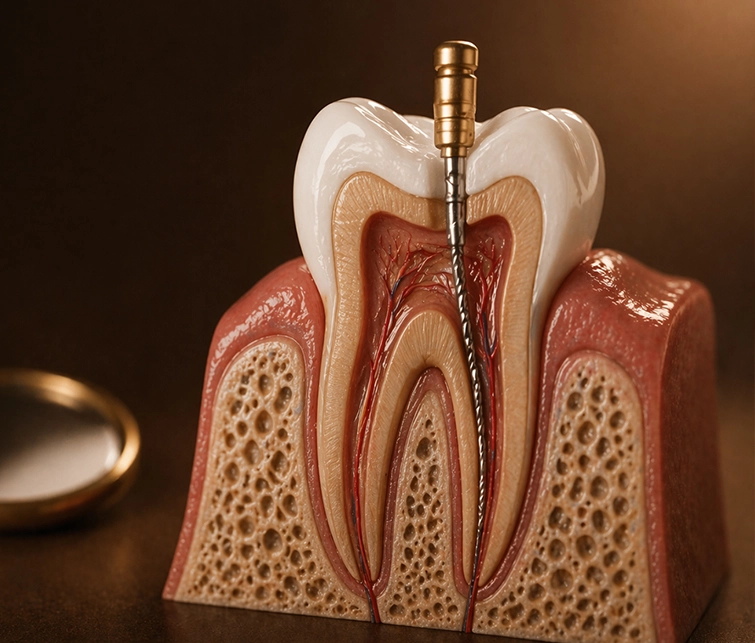
Root canal treatment removes infected or dead tissue from inside the tooth and fills the canals. The source of the pain is gone.
Keeping your own tooth is usually better than extracting it and replacing it with an implant or bridge. What our patients mention most is that it was painless.
Who it's for
Does one of these sound familiar?
- Throbbing toothache that wakes you at night
- Lingering ache after hot or cold
- Pain when chewing
- Swelling or a pimple-like bump on the gum
- The tooth has darkened
- Deep decay or a fracture
Process
Step by step.
Usually 1–2 sessions, depending on the infection.
Exam and X-ray
We image the number of canals and the extent of the infection.
1 sessionCleaning
The canals are cleaned and shaped under local anaesthesia.
1 sessionFilling
The canals are permanently filled and sealed.
Same or next sessionFinal restoration
The tooth is strengthened with a filling or crown.
1 sessionFAQ
Root canal treatment FAQ
Does a root canal hurt?
It's done under local anaesthesia, so you won't feel pain. There may be mild sensitivity for a few days afterwards.
Is it done in one session?
For most teeth, yes. If there's heavy infection, medication is placed in the canal and treatment is completed at a second session.
How long does a root-canal-treated tooth last?
With a proper filling or crown on top, it lasts for many years.
Why not just extract the tooth?
Your own tooth protects the bone and neighbouring teeth. An extracted tooth will later need an implant or bridge.